Bharat Ratna
Becomes the first sportsperson to receive India's highest civilian award.[1]
The key moments of a career that ran from 15 November 1989 to 16 November 2013.
Born at the Nirmal Nursing Home in Dadar, Bombay, and named after music director Sachin Dev Burman.[1]
His elder brother Ajit takes him to coach Ramakant Achrekar at Shivaji Park, Dadar.[1]
Serves as a ball boy at the India v England World Cup semi-final in Bombay.[1]
Bats with Vinod Kambli in an unbroken 664-run partnership in the Lord Harris Shield, scoring 326 not out.[1]
Aged 15, scores 100 not out for Bombay against Gujarat at the Wankhede Stadium on debut.[1]
Debuts against Pakistan in Karachi aged 16 years and 205 days, the youngest to debut for India in Tests. He scores 15.[1]
Debuts in ODIs against Pakistan at Gujranwala and is dismissed without scoring.[1]
Makes 119 not out at Old Trafford, Manchester, becoming the second-youngest cricketer to score a Test century.[1][2]
At 19 he becomes the first overseas-born player to represent Yorkshire.[1]
Five years after his ODI debut, he makes 110 against Australia at the R. Premadasa Stadium, Colombo.[2]
Finishes the 1996 World Cup as its highest run-scorer with 523 runs.[1]
Scores 143 against Australia in Sharjah, in an innings interrupted by a sand storm.[1]
Scores 1,894 ODI runs in the calendar year, a record.[1]
Scores 673 runs at the 2003 World Cup and is named Player of the Tournament.[1]
Makes 248 not out against Bangladesh in Dhaka, his highest Test score.[1][2]
Scores a record-breaking 35th Test century against Sri Lanka at the Feroz Shah Kotla, Delhi.[1]
Becomes the first player to reach 15,000 ODI runs during the Future Cup against South Africa.[1]
Receives the Sir Garfield Sobers Trophy at the ICC Awards.[1]
India beat Sri Lanka in the final at the Wankhede Stadium, Mumbai. It was his first win in six World Cups.[1][3]
Reaches the mark against West Indies in New Delhi.[1]
Scores 114 against Bangladesh at Mirpur for his 100th international century.[1][2]
Plays his final ODI, against Pakistan.[1]
His international career ends after his 200th Test, against West Indies in Mumbai. It spanned exactly 24 years.[1][4]
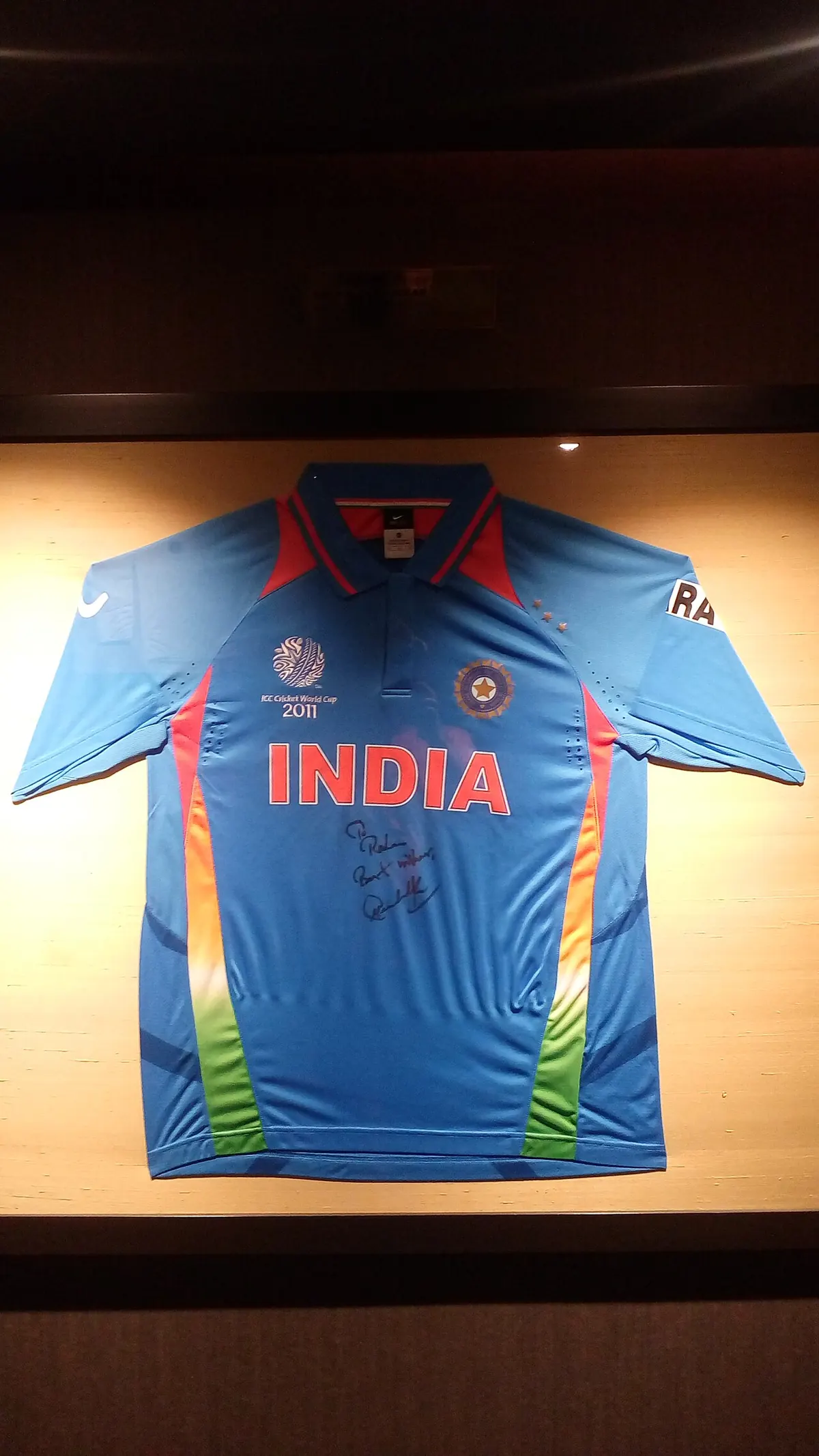
His 2011 World Cup winning jersey on display at Blades of Glory Cricket Museum, Pune. Photo: DesiBoy101, CC BY 4.0, via Wikimedia Commons (resized).
Retrieved 20 November 2026. Figures are as listed by these sources on that date.